


How to Stop a Newborn From Scratching Their Face: 2026

To stop a newborn from scratching their face, keep their nails short and smooth, and use a properly fitted hand covering when needed. Mitts can help block sharp nail edges, but they don't replace nail care, regular fit checks, or a pediatrician's advice when your baby's skin looks irritated.
- How to stop a newborn from scratching their face: smooth nail edges first, then check fit and skin.
- Goumikids stay-on mitts offer a separate hand covering; they don't replace newborn nail care.
- Leave hands uncovered during supervised awake time so your baby can touch and explore.
- Call your pediatrician about worsening redness, swelling, drainage, or a scratch near the eye.
How do you stop a newborn from scratching their own face?
Start with the nails, not with tighter mitts. A tiny rough edge can catch skin when your newborn brings a hand toward their cheek. Keeping that edge smooth addresses the cause of an accidental scratch.
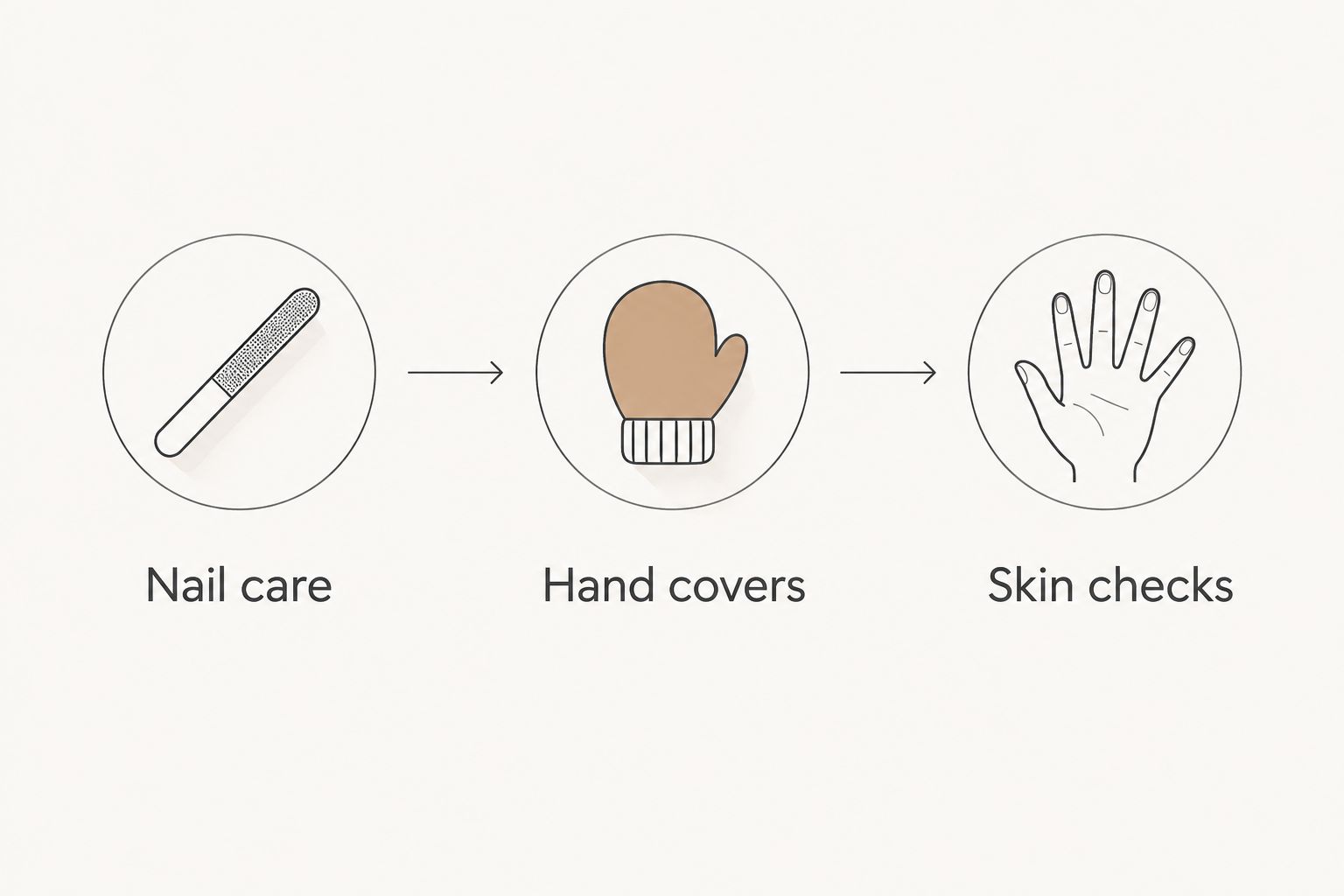
Use this simple order:
- Nail care: Look for sharp corners and gently smooth them with an infant nail file.
- Hand covers: If scratches continue, check whether a properly fitted mitt or an existing fold-over cuff suits the moment.
- Skin checks: Look at your baby's cheeks, fingers, and wrists when you remove the covering.
A covering puts fabric between the nail and the face. It doesn't stop your baby's hands from moving, and it doesn't treat itchy or inflamed skin. The guide to how no-scratch mittens work explains that distinction.
You don't need to stop every hand-to-face movement. You need to reduce sharp edges, keep clothing comfortable, and notice when the problem is more than an accidental scratch.
Why this matters
Finding a fresh line on your baby's cheek can feel upsetting, especially when you just checked their nails. Newborn hand movements aren't well controlled yet. A hand brushing the face isn't evidence that you've done something wrong.
The useful distinction is accidental scratching versus irritated skin. A rough nail needs nail care. A spreading rash, repeated rubbing, or broken skin needs a closer look and sometimes medical advice.
For your 2026 newborn checklist, make nail care easy to reach rather than building a complicated routine. An infant file beside your changing supplies is more useful than a drawer full of coverings you haven't checked for fit.
Smooth the edge, gently
Check your newborn's nails in good light. Run your own fingertip gently along the edge to find a corner that feels sharp. You don't have to wait for a nail to look long before smoothing a snag.
An infant nail file lets you work on a small rough edge without cutting. Support the finger, use gentle strokes, and keep the file away from the surrounding skin. Stop if your baby pulls away or you can't see clearly.
If you use infant nail clippers or scissors, choose a calm moment and hold the fingertip steady. Gently move the finger pad away from the nail before cutting. Don't dig into the sides or try to cut the nail as short as possible.
Don't bite or peel your baby's nails. Biting introduces germs, while peeling can pull beyond the loose edge and hurt the skin. A lifted corner is a reason to file carefully, not tug.
You can split the task across separate calm moments. Finishing every nail at once matters less than avoiding a rushed cut. If you're nervous, ask your pediatrician or nurse to show you how to hold the fingertip safely.
Choose the tool for the moment
Nail care and hand coverings do different jobs. You don't have to choose one forever, and you don't need every option below.
| Option | Best for | What it helps with | Limitation or caution |
|---|---|---|---|
| Infant nail file | Smoothing a rough edge | Removes the snag that catches skin | Takes patience; avoid rubbing nearby skin |
| Infant nail clippers | Trimming a clearly visible nail edge | Shortens the nail | Can nick skin if your baby moves |
| Separate baby mitts | Temporary hand coverage | Places fabric between nails and the face | Needs fit checks; a loose mitt can come off |
| Attached fold-over cuffs | Coverage on clothing that already includes cuffs | Covers hands without a separate mitten | Not every garment has them; sleeves still need to fit |
For 2026 baby shopping, choose by the task rather than the label. A covering described as no-scratch is still a fabric barrier. It isn't a guarantee that your baby won't touch their face or develop another mark.
Check the exact garment before assuming it includes hand coverage. A gown, footie, or romper isn't automatically a substitute for mitts. Features vary by style and size.
Mitts: helpful coverage, not an all-day rule
Goumikids stay-on mitts are best for parents looking for a separate hand covering. They're an option when you'd like fabric between your newborn's nails and cheeks without changing the whole outfit.
The Stay-On Baby Mittens Midnight is one relevant option. Check the current item's sizing, closure instructions, fabric details, and care label before choosing it. Don't assume another style has identical features.
The benefit of separate mitts is flexibility: you can remove them without undressing your baby. The trade-off is another small item to fit, check, wash, and keep track of. Goumikids mitts don't replace keeping nails smooth or checking the skin underneath.
A secure fit is not the same as a tight fit. Your baby should have room to move their fingers, and the wrist shouldn't look squeezed. Remove a covering that leaves marks, bunches awkwardly, or slips off easily.
Never add strings, tape, elastic bands, or safety pins to keep mitts on. If a covering won't stay in place as designed, choose a different fit rather than improvising a fastening.
Fold-over cuffs: check the actual sleeve
An attached cuff can be convenient when your baby's outfit already has one. Fold it according to the garment's instructions, then check that the covered hand isn't cramped. The sleeve shouldn't pull against the arm.
Attached cuffs also have a limit: the sleeve determines the fit. If the garment is too small, closing the cuff doesn't solve that problem. If it's too large, fabric can bunch around the hand.
Leave the cuff open during supervised awake time when coverage isn't needed. Your baby can touch your hand, bring their hands together, and explore without fabric in the way. Keeping every movement covered isn't the goal.
For a 2026 registry, inspect the exact item rather than relying on a category name. Choose the clothing you need for dressing and diaper changes, then confirm whether hand coverage is included.
Why your newborn keeps getting scratches
Repeated scratches don't always mean you need a different mitten. Check these factors before adding more clothing:
- Nail edges: A short nail can still have a sharp corner. Look for the snag, not just the length.
- Hand movements: Newborns bring their hands toward their faces without precise control. Coverage doesn't change that movement.
- Covering fit: A slipping mitt exposes the nail again. A tight mitt creates a different problem.
- Skin irritation: Dry, inflamed, or rash-covered skin needs attention beyond covering the hands.
- Changing fit: Your baby's clothing fit changes as they grow. Recheck sleeves and mitts rather than relying on the original size label.
Keep your response matched to what you see. Smooth a rough edge. Remove a poor-fitting covering. Ask about skin irritation instead of assuming every mark is another nail scratch.
What should you do when you find a scratch?
For a small surface scratch, gently clean the area with water and pat it dry. Don't scrub the mark or use harsh products to make it disappear faster. Ask your pediatrician before applying a medicated cream near your newborn's eyes or mouth.
If the scratch is bleeding, hold gentle pressure with clean gauze or a clean cloth. Contact your pediatrician if bleeding doesn't stop, the cut looks deep, or you aren't sure whether the eye itself was touched.
Don't put a loose adhesive bandage on your newborn's face. It can come off near their mouth. Get advice about a wound that needs protection rather than choosing a dressing on your own.
Watch for increasing redness, warmth, swelling, or drainage. Those changes need medical advice, not just a new pair of mitts. A newborn who seems unwell needs prompt attention even when the scratch looks small.
When should you call the pediatrician?
Call your pediatrician about a scratch near the eye, a deep wound, persistent bleeding, or signs of infection. Repeated face rubbing with a rash also deserves a conversation. Describe what you see rather than trying to name the condition yourself.
A rectal temperature of 100.4°F (38°C) or higher in a baby younger than 3 months needs immediate medical advice. Don't wait to see whether a scratch or rash improves first. Fever at that age matters independently of the skin mark.
If your baby has trouble breathing, is difficult to wake, or appears seriously unwell, seek emergency care. A hand covering isn't the next step in that situation.
For a baby receiving NICU care, ask the care team before adding mitts or changing clothing. Access to the hands and monitoring needs take priority over an everyday dressing routine.
Can a newborn sleep with mittens on?
Don't treat mittens as automatically suitable for sleep. Check the product instructions, fit, and your pediatrician's guidance, especially if a mitt comes off easily. Never leave a detached covering in your baby's sleep space.
The American Academy of Pediatrics recommends placing babies on their backs on a firm, flat sleep surface with no loose bedding or soft objects. Keep that rule central to your 2026 nighttime routine. Don't add a blanket, positioner, or restraint to prevent face scratching.
Attached cuffs avoid a separate mitten, but they still require a properly fitting garment. Hand coverage doesn't replace safe-sleep practices, and you shouldn't expect it to improve sleep.
How often should you check newborn nails?
Check for rough edges whenever you notice a new scratch and during ordinary care moments. There isn't a single trimming schedule that fits every newborn. Nail growth and the need to smooth an edge vary.
A quick look during a diaper change is enough to spot a snag. If your baby is upset or your lighting is poor, leave the trimming for a calmer moment. You don't need to make every diaper change a nail-care appointment.
When can you leave your newborn's hands uncovered?
Leave hands uncovered during supervised awake time when sharp nails aren't causing a problem. Hands help babies touch, explore, and bring their fingers toward their mouths. Coverage should solve a specific need, not become an automatic all-day layer.
Try uncovered time after smoothing rough edges. If a new scratch appears, inspect the nails and skin again. Don't use a fixed age as the only reason to keep mitts on or take them off.
FAQ
What's the best way to stop a newborn from scratching their face in 2026?
Keep nail edges short and smooth, then use a properly fitted hand covering when needed. Check the skin and fit regularly instead of relying on mitts alone.
Do newborn mittens replace cutting or filing nails?
No, newborn mittens don't replace nail care. They put fabric between the nails and face, but sharp edges still need attention.
Can my newborn wear mittens all day?
Don't make mittens an automatic all-day layer. Remove them for supervised awake time when coverage isn't needed, and check the hands and wrists regularly.
Are fold-over cuffs better than separate baby mittens?
Fold-over cuffs avoid a separate mitten, while separate mittens can be removed without changing the outfit. Neither option solves poor fit or replaces smoothing sharp nails.
Should I put socks on my newborn's hands?
Don't assume a sock fits safely as a hand covering. Choose an item intended for hands, follow its instructions, and never add makeshift fasteners.
What if my newborn scratches near their eye?
Contact your pediatrician if a scratch is near the eye or you think the eye itself was touched. Don't put medicated products near the eye without guidance.
When is a fever urgent for a newborn with a scratch?
A rectal temperature of 100.4°F (38°C) or higher in a baby younger than 3 months needs immediate medical advice. Don't wait for the scratch to heal before calling.
Will Goumikids mitts stop every facial scratch?
Goumikids mitts provide hand coverage, not a guarantee against every scratch. Keep nails smooth, check the exact item's fit, and ask your pediatrician about irritated skin.
One last thing
A nail doesn't have to look long to cause a scratch. One tiny rough corner can be the part you keep missing.
Before you buy another covering, gently check each nail edge in good light. The most useful next step is often smoothing the snag, not covering the hand more tightly. That's a small task you can return to when your baby is calm.