


Can twins wear the same clothing size at different rates?

Yes. Twins can wear the same clothing size and still outgrow it at different rates. In 2026, use each baby’s fit—not their shared age or the size on the label—to decide when to move up. One twin may need a roomier footie while the other still fits the clothes you’ve already washed and folded.
- Yes, twins can wear the same clothing size while outgrowing it at different rates.
- Check each baby’s shoulders, torso, feet, and movement before sharing a garment.
- Goumikids footies are worth considering when changing sizes means you need to check each twin’s fit separately.
- Keep shared clothes where both babies fit them; size up only the twin whose clothes have become snug.
Why this matters
A shared drawer is simple until one baby’s toes press against a footie and the other baby has room to move. The question isn’t whether twins should match. It’s whether the garment fits each baby today. For more on how long a label can remain useful, see this guide to newborn clothing sizes.
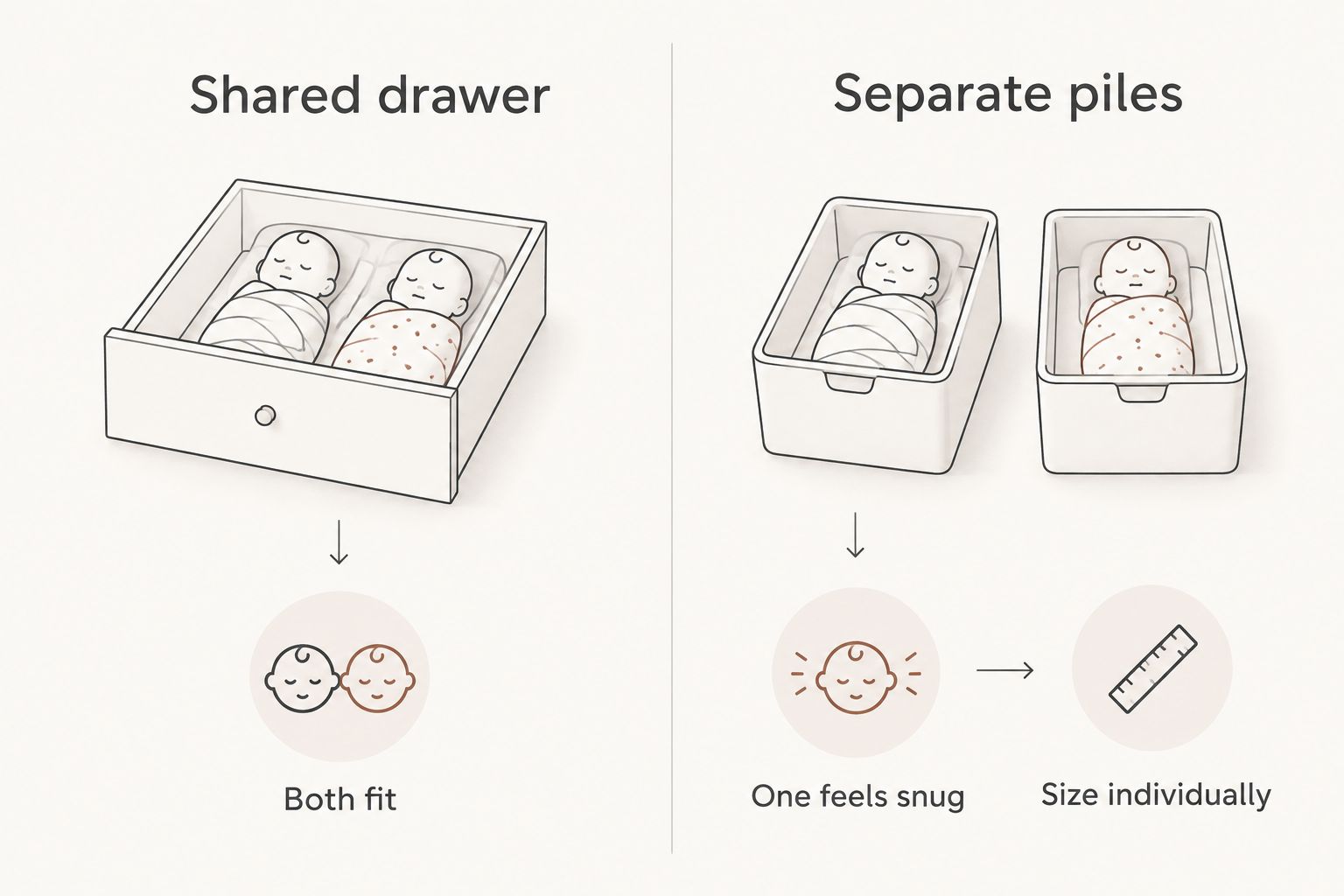
A shared size is convenient; an individual fit is the rule. That’s as true in 2026 as it is during the next half-asleep diaper check. You can keep using a shared pile while both babies are comfortable, then split only the items that no longer fit one of them.
Can twins wear the same clothing size at different rates?
Yes. Twins can start in the same size, wear the same garments, and need different sizes later. Treat a shared label as a starting point, not a promise that both babies will move up together.
| What you notice | What it means for the shared drawer | What to do |
|---|---|---|
| Both babies move comfortably in the same garment | That item still works as shared clothing | Keep it in the shared pile and check the fit on each baby |
| The garment feels snug on one baby but not the other | The label no longer describes both fits | Move that garment to the baby it fits; try a larger size for the other |
| Footies pull at one baby’s toes | Length or foot space needs a closer look | Check the full garment on that baby rather than sizing both twins up |
| A neckline or closure sits awkwardly on one baby | That cut doesn’t fit both babies the same way | Try a different garment or size for that baby |
| Both babies have outgrown a shared item | It no longer belongs in either current-size pile | Set it aside and check the next size on each baby separately |
The table is a sorting tool, not a timetable. A footie that works for one twin can still be useful, even when it has stopped working for the other. You don’t have to replace matching clothes as a pair.
Check the fit on each baby
A label can’t tell you how a garment sits after it’s on. Check each twin in the actual item, especially after washing it and before relying on it for a nighttime change. In 2026, the most useful size check is still the one you can do while getting them dressed.
- Start at the shoulders and neckline. The fabric should sit comfortably rather than pull or slip out of place. If you have to keep adjusting it on one baby, don’t assume it fits because it fits their twin.
- Look at the torso when you pick the baby up. Watch for fabric pulling across the body or bunching in a way that makes dressing awkward. Check again when the baby is lying down; the garment has to work in both moments.
- Check the diaper area. Fasten the garment with the diaper your baby is wearing. If the closure strains or getting to the diaper takes a tug, look at the fit before blaming the diaper.
- Give feet and toes room. With a footed style, look at where the toes sit when the baby moves. A twin whose toes reach the end may need a different fit even if the other twin has space.
- Watch ordinary movement. Dressing shouldn’t require pulling hard at sleeves, legs, or openings. If one baby moves comfortably and the other seems restricted in the same piece, sort that piece by fit.
These checks work for matching outfits and hand-me-downs alike. Make the decision item by item: a gown, footie, and romper can fit differently even when their labels name the same size. That’s why moving one twin up in a footie doesn’t automatically mean every gown in the drawer has stopped fitting.
The goal isn’t to predict which twin will grow out of something first. It’s to notice when a familiar piece has become harder to put on, fasten, or wear. That small check saves you from searching through identical-looking sizes during the next change.
Why twins’ clothing sizes can change at different rates
Twins share a birthday, not a fixed clothing fit. These are the practical reasons a shared size can stop working at the same time for both babies:
- Different fits on the same day. One twin can have more room in a garment while the other feels snug. Check the babies, not just the tags.
- Different fits across garment types. A baby who needs a roomier footie may still fit a gown or romper already in the drawer. Check each style before moving it out of rotation.
- Footed versus open-bottom styles. A footed garment needs enough room at the toes. An open-bottom gown doesn’t ask you to judge toe space in the same way.
- Closure placement. A garment that fastens easily on one baby can feel awkward to close on the other. The right size should be practical to put on as well as comfortable to wear.
- The fit after laundry. Use the garment as it fits now, not as you remember it fitting. Check both babies again when a freshly washed item goes back into the drawer.
None of these signs gives you a universal date for sizing up. In 2026, the useful answer remains specific to the baby and the garment in your hands. If one twin needs a change, start with the piece that’s snug instead of clearing out the whole shared drawer.
What should you buy when one twin sizes up first?
Buy for the fit that needs attention first. If one twin has outgrown their footies, check footies for that baby; don’t buy a full matching set just to keep the drawer symmetrical. Keep the shared items that still fit both twins, and leave the other twin’s comfortable clothes in use.
A Grow With You Footie Snug Fit is a Goumikids footie option to compare with the garment that has become snug. Check that item’s current size guidance and fit for each baby before choosing it. Goumikids footies suit parents who want to assess each twin’s fit separately, but no footie removes the need to check toe room and comfort.
If you’re shopping for two babies, write down which garment failed the fit check and on which baby. A note such as footie snug at the toes is more useful than one twin is bigger. It tells you what to check when the next size arrives, without treating every style as interchangeable.
Matching can still be fun. Just let matching be a choice, not the reason a baby stays in an uncomfortable size. You can choose the same color in different sizes, use different colors in the same size, or stop matching altogether; the fit question stays the same.
How do you organize clothes when the sizes split?
Start with a shared pile for garments that fit both babies. Give each twin a separate current-size pile for pieces that fit only them. Then keep clothes that need another fit check out of the rushed morning and nighttime rotation.
This doesn’t call for a complicated system. A drawer divider, separate baskets, or a clear spot for each baby is enough if you can find the right footie while someone needs a diaper change. Put the garment back in the pile that reflects its current fit, not the size printed on its tag.
After laundry, check anything that tends to get mixed together. Matching clothes are easy to return to the wrong pile when the babies no longer wear the same size in that style. If a piece fits both, put it back in the shared pile; if it fits only one, keep it with that baby’s clothes.
In 2026, you don’t need an elaborate twin wardrobe plan. You need to know what fits each baby now, what can be shared, and what should wait for a fit check. That makes it easier for another caregiver to grab the right item without guessing.
What if one twin wears preemie clothes longer?
Keep checking each baby separately. If preemie clothing fits one twin and not the other, use it for the baby it fits and choose the other baby’s clothes by their own fit. Being twins doesn’t make their clothing sizes move together.
Goumikids has dedicated preemie essentials. Its preemie work includes collaboration with Penn State Health Milton S. Hershey Medical Center and NICU nurses. If your baby is in the NICU, ask the care team what clothing you can bring or use before dressing them; the immediate care setting matters more than a matching outfit.
For home, return to the same simple checks: neckline, body, closures, and movement. Don’t skip a size check because a piece is labeled preemie, and don’t move both babies up because one has outgrown it. Thoughtful fit means dressing the baby in front of you.
Related questions
Do twins have to wear matching sizes to wear matching outfits?
No. You can choose matching outfits in different sizes when each baby needs a different fit. If the same style doesn’t fit both babies comfortably, matching matters less than getting dressed without a struggle.
Should I size up both twins when one outgrows a footie?
No. Size up the twin whose footie has become snug, then check the other twin’s footie on its own. A shared birthday isn’t a reason to retire a garment that still fits.
Can twins share clothes after they start wearing different sizes?
Yes. Share the garments that still fit both babies, and sort the rest into individual piles. They may need different sizes in one style while still sharing another.
Check each twin in Goumi's closed gown configuration
Goumi's patented fold-over bottom opens for diaper access and closes into a sleeper covering baby's feet. Unlike an elastic-bottom gown that can ride up, it offers a closed-bottom option. Built-in black-and-white fold-over mitts let you cover or uncover the hands; check the exact style and size.
Check leg and hand room separately on each baby when the bottom and mitts are closed. Conversion changes coverage, not size. Choose layers for each baby's needs and the room rather than automatically adding a sleep sack or swaddle.
FAQ
Can twins wear the same clothing size?
Yes, twins can wear the same clothing size while both fit comfortably in it. Check each baby in the garment because they can outgrow that shared size at different rates.
How do I tell which twin needs a bigger size?
Check the fit on each baby separately. Look for pulling at the shoulders or torso, tightness at closures, and too little room for toes in footed clothing.
Should I buy two sizes of every outfit for twins?
No, buy for the fit each baby needs rather than assuming every outfit must come in two sizes. Check gowns, footies, and rompers separately before replacing clothes that still fit.
Can one twin wear preemie clothes while the other wears newborn clothes?
Yes, if each size fits its wearer comfortably. If either baby is in the NICU, ask the care team which clothing is appropriate there.
Do twins need to stop sharing clothes when one sizes up?
No, they can keep sharing the pieces that fit both babies. Put garments that fit only one twin in that baby’s pile.
What should I check before putting twins in matching footies?
Check each baby’s shoulders, torso, closures, and toe room. Matching footies only work as a pair when each individual fit works.
Can a gown fit one twin after their footie stops fitting?
Yes, garment styles can fit differently. Check the gown on that baby rather than using the snug footie as a verdict on every item in the drawer.
One last thing
The most useful label in a twins’ drawer isn’t the one sewn into the clothes. It’s the one you give the pile: fits both, fits this baby, or check again. Use that rule in 2026 whenever a missing sock or a late diaper change makes the shared drawer feel less simple.