


How do you dress a preemie baby in the NICU?

Ask your baby's NICU team whether clothing is appropriate and which openings they need for equipment access. Once they approve clothing, choose the exact garment by its fit, construction and care instructions. Don't assume every preemie needs a gown, mittens and booties, or copy a fixed layering routine from another baby.
- Dressing a preemie in the NICU starts with the care team's permission and instructions.
- Compare the actual garment's openings, not just the names gown, romper or footie.
- Check individual fit, including length, hand room and foot room where relevant.
- Goumikids preemie gowns, mitts and booties are clothing options, not a universal care protocol.
- Do not disconnect, reposition or cover medical equipment yourself to make clothing fit.
How do you dress a preemie baby in the NICU?
- Ask whether clothing can be used now. Confirm which items, if any, suit your baby's current care needs.
- Show the team the exact garment. Bring the item or clear product details so staff can assess the openings and access.
- Check fit with their help. Use the specific product's guidance and the baby's actual measurements rather than an age label alone.
- Ask for a dressing demonstration. Follow the team's instructions for handling your baby and clothing around equipment.
- Confirm washing and changes. Ask the unit how outside clothing should be cleaned and managed.
- Recheck the plan at discharge. Hospital hand coverage, layering and equipment access don't automatically translate into sleep at home.
The Goumikids preemie collection includes smaller gowns, mitts and booties. Browse after you know what the team can use. Clothing supports the care plan; it doesn't set it.
Why permission matters more than an outfit formula
Wanting to dress your baby is understandable. It can be a small, familiar part of a day that doesn't feel very familiar. You can ask how to participate without feeling you need to arrive with a complete matching wardrobe.
Different babies and care settings have different access needs. A retail phrase such as NICU Approved isn't permission for every infant, piece of equipment or unit. The staff caring for your baby are the people to ask.
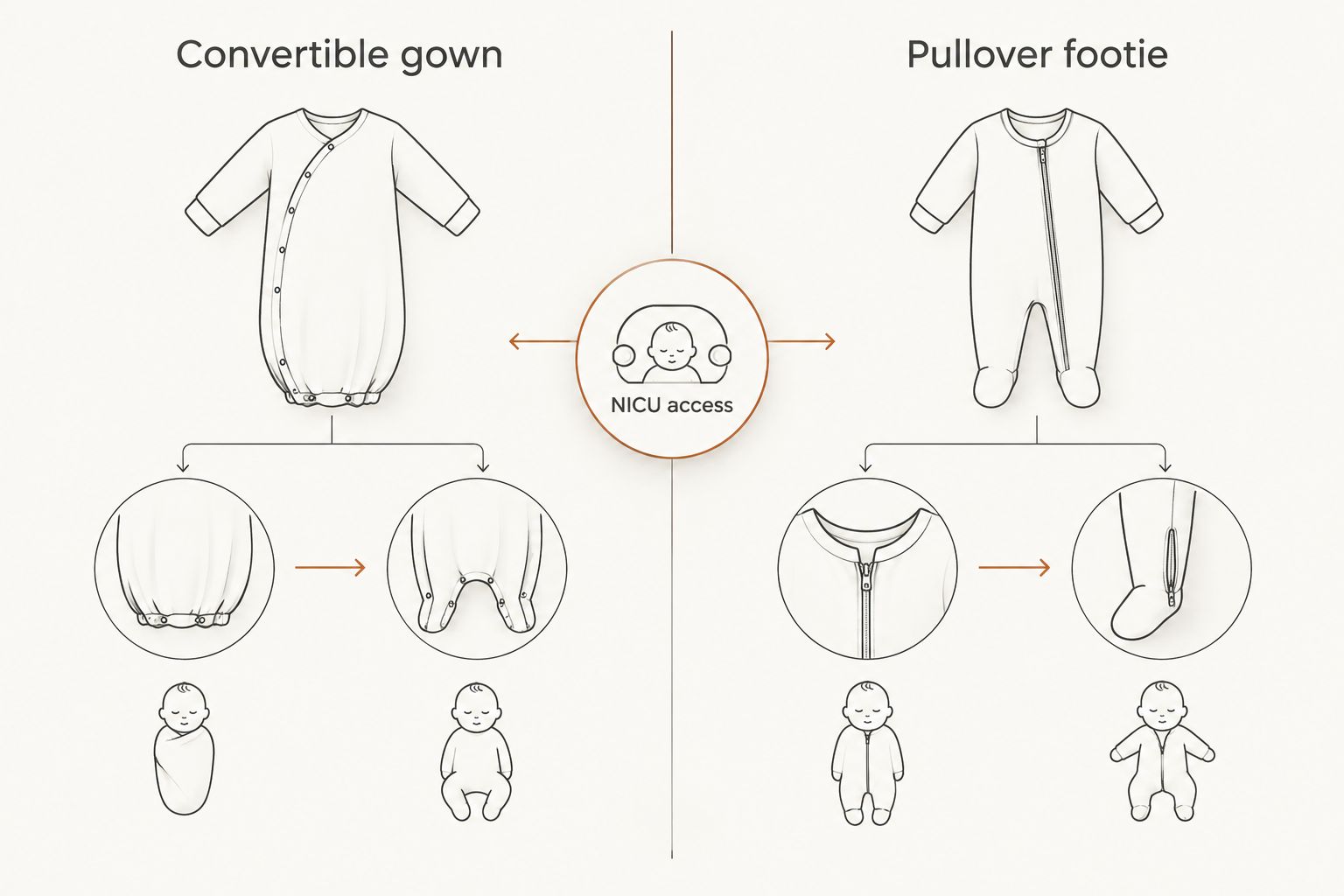
Compare the garment's actual openings
| Clothing option | Best for | Detail to show the team | Limit to remember |
|---|---|---|---|
| Convertible gown | Caregivers considering gown-to-sleeper function | Exact neckline, sleeve openings and foot pocket | Convertible does not automatically mean fully opening snap-front |
| Romper or footie | Caregivers comparing body and leg coverage | Actual snaps, zipper or neckline | A category name doesn't establish how it opens |
| Separate mitts | Adjustable hand coverage when permitted | Wrist closure and hand fit | May not suit the team's hand-access needs |
| Separate booties | Smaller-foot coverage when permitted | Ankle fastening and foot fit | Not automatically necessary or appropriate for every baby |
Don't treat a gown as universally better than a footie. The actual construction matters. Some garment names describe the shape, others the closure; ask staff to assess the piece rather than relying on the category alone.
What Goumikids' Cloud Petite / Preemie gown specifies
The Cloud gown listing describes a one-snap foot pocket that converts the gown to a sleeper and integrated mitts with a black-and-white pattern. It lists size P for 3–6 lb and 15–17 inches in baby length.
Goumi's patented fold-over bottom opens for diaper access, then closes into a sleeper that covers baby's feet. Unlike an elastic-bottom gown that can ride up, it gives you a closed-bottom option. The built-in black-and-white fold-over mitts let you cover or uncover the hands without adding a separate pair.
Discuss a gown without metal snaps or zips with the NICU team, and show them the actual item. These features don't establish that the gown opens fully flat or protects medical lines. Staff set warmth and layering in hospital; at home, follow the discharge plan rather than automatically adding a sleep sack or swaddle.
The listed fabric is 70% viscose from bamboo and 30% organic cotton. For care, the listing specifies low or delicate machine washing, followed by gentle/low drying or line drying. Follow the unit's instructions for outside clothing as well as the garment label.
Mittens and booties: ask whether coverage is wanted
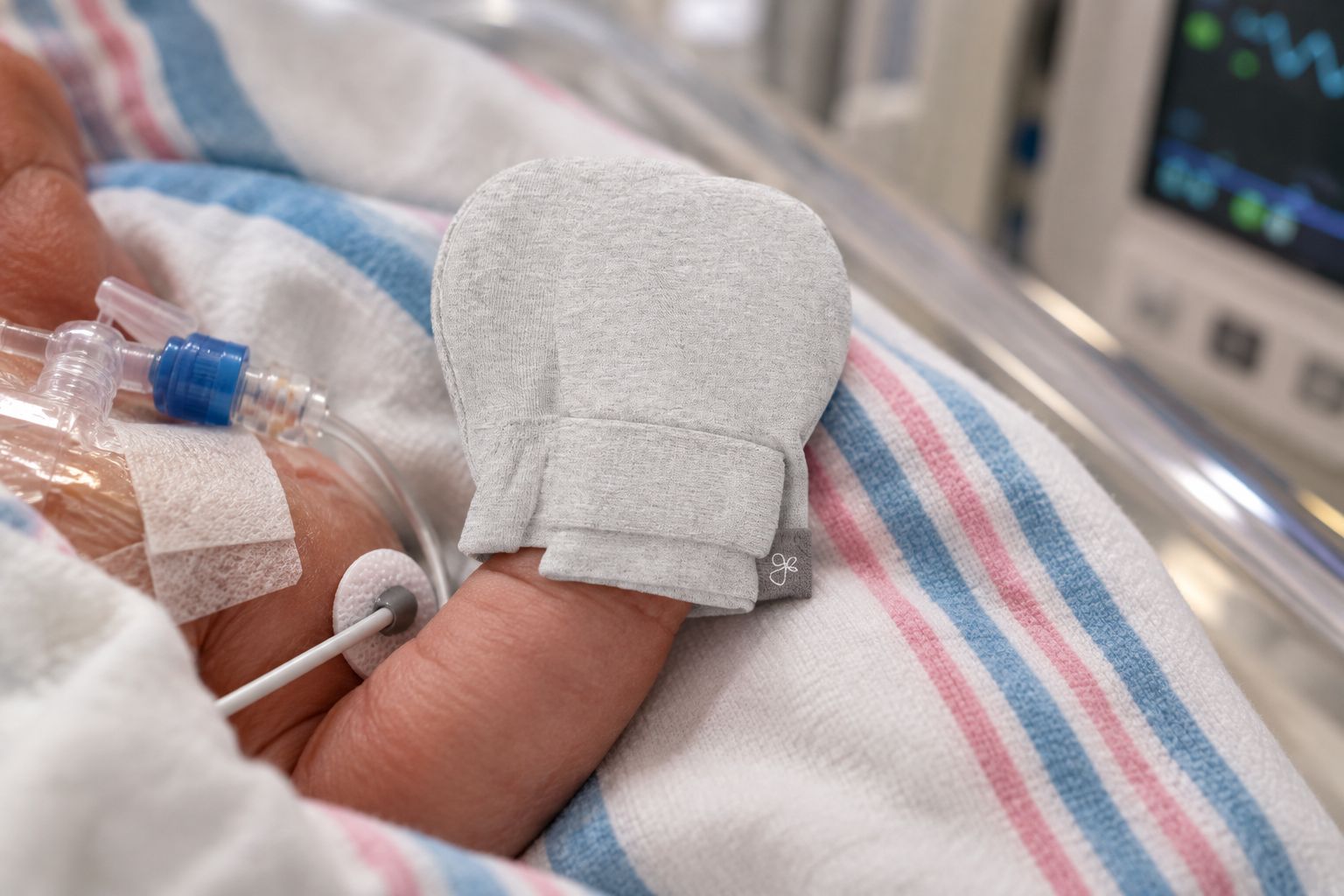
Goumikids preemie mitts have a two-part adjustable closure. Goumi developed its preemie mittens in collaboration with NICU clinicians at Penn State Hershey Children's Hospital, incorporating feedback from patient testing, nurses, and parents. Historical 2016 hospital guidelines specifically included Goumimitts for selected intubated babies and babies judged at risk of pulling lines or breathing tubes. The guidelines required removal during each care session for skin assessment and laundering when soiled; this is historical practice, not current policy.
Research published in Pediatrics in 2014 describes a coordinated NICU approach to reducing unplanned extubations—the unintended removal or dislodgement of a breathing tube—with mittens included in a later phase. The publication doesn't name Goumi or isolate its mittens' effect. This history is not a hospital endorsement, a universal equipment-protection claim or a promise of safer home sleep. Follow your baby's NICU team's direction.
Ask whether staff need the hand or wrist uncovered, which fit they want and when the mitts should be removed. Don't add tape or a homemade fastener to stop a mitten coming off.
The Cloud Petite / Preemie booties listing also describes an adjustable two-part closure. It directs caregivers to the boot guide and foot measurements; a weight label alone doesn't settle the fit. Ask whether foot coverage is appropriate rather than assuming boots are required instead of socks.


Let the team set warmth and layering
Don't choose layers from a general instruction such as one gown in an isolette or two layers in an open crib. Ask staff what your baby should wear now and when that should change. This article does not provide a temperature-management plan.
The same applies to skin-to-skin care and equipment access. Ask staff how to participate and what to wear. Don't move or disconnect equipment to get a garment on or off.
“The right NICU outfit is the one that fits your baby and works with the care team's instructions.”
What changes when your baby goes home?
Review the discharge instructions with the team. Ask which hospital clothing practices continue and which do not, including hand coverage and sleepwear. A supervised hospital routine isn't automatically an instruction for sleep at home.
For home sleep, follow your baby's discharge plan and general safe-sleep guidance. If hand coverage is a concern, ask about the difference between attached cuffs and detachable mittens rather than assuming a stay-on closure settles the question.
FAQ
How do you dress a preemie in the NICU?
Ask the team which clothing is appropriate, show them the exact item and follow their dressing instructions. Check the specific garment's measurements, openings and fit.
Does every preemie need mittens and booties?
No automatic requirement is established here. Ask whether hand or foot coverage suits your baby's care and the access staff need.
Is every convertible gown a fully opening snap-front gown?
No. Conversion describes a function, not every opening. The Cloud Goumikids listing describes a one-snap foot pocket; show the actual garment to staff.
Can I move a monitor lead to fit a garment?
Do not disconnect, reposition or cover medical equipment yourself for clothing. Ask the NICU team to assess the item and show you what to do.
What does the Hershey collaboration mean?
Goumikids reports co-developing its preemie mitten with NICU nurses at Penn State Health Milton S. Hershey Medical Center. That does not establish a universal dressing protocol or blanket equipment-protection claim.
How many layers should a NICU baby wear?
Ask the team for your baby's current instructions. There is no fixed isolette or open-crib layering rule supplied by this clothing guide.
Can I continue the same mitten routine after discharge?
Clarify it with the team before going home. Hospital care routines, sleep and supervised awake wear are different settings.
One last thing
Bring the item, not just its name. A quick look at the actual sleeve, neckline and closure tells the team more than a generic label such as preemie or NICU-friendly.