


Is bamboo fabric safe for a newborn's skin?

Yes, bamboo-derived fabric can be safe against a newborn’s skin when the finished garment fits comfortably, is washed as directed, and does not irritate your baby. The word bamboo alone does not tell you how the fabric was made or whether your baby will tolerate it, so check the actual fiber label and your baby’s skin rather than relying on the name.
- Bamboo fabric can be safe for newborn skin, but the finished garment and your baby’s reaction matter more than the fiber name.
- Goumikids bamboo-organic-cotton essentials are best for parents who also want practical features, such as adjustable closures.
- Check the fiber label, wash the garment before wear, and stop using it if irritation appears.
- A soft feel is not proof that a garment will suit every newborn’s skin.
Why this matters
When you’re dressing a newborn half asleep, soft fabric is only part of the job. A seam that rubs, a damp cuff, or a closure that shifts can make an otherwise comfortable outfit frustrating to use. The question in 2026 isn’t whether bamboo sounds gentle. It’s whether the finished item works for your baby.
Goumikids offers stay-on 2-pack mitts in Storm Gray and Gridlock labeled as a bamboo-organic-cotton blend. Their two-part closure addresses a familiar problem: mitts that come off. That feature helps with fit, but it does not replace checking the fabric label or watching for rubbing around the wrist.
Is bamboo fabric safe for a newborn’s skin?
Yes, a newborn can wear bamboo-derived fabric if the finished clothing is comfortable and does not cause irritation. No fiber name guarantees that outcome. Start with the item in your hands: read its care and fiber labels, wash it before use, and check the skin where fabric, seams, and closures touch.
Clothing sold as bamboo is often made with a processed, bamboo-derived fiber rather than woven directly from raw bamboo. A label that identifies the actual fiber tells you more than a product name does. It also helps you distinguish a bamboo-derived fabric from a blend that includes cotton or another material.
Here’s a practical comparison for 2026. It describes what to check, not a ranking of which fiber is safest for every baby.
| Clothing option | Best for | What works | What to watch |
|---|---|---|---|
| Bamboo-derived fabric | Parents who like its feel | Can feel soft against skin | The word bamboo does not identify every fiber, finish, or care requirement |
| Organic cotton | Parents who prefer a cotton fiber label | Makes the fiber choice straightforward | Seams, fit, and laundering can still affect comfort |
| Bamboo-organic-cotton blend | Parents who want to consider both fibers | Gives you another fabric option | The blend name alone does not establish the proportions or your baby’s tolerance |
None of these labels is a diagnosis or a promise against irritation. If you already know your baby reacts to a particular garment, set that garment aside. If irritation persists or looks concerning, ask your baby’s clinician rather than trying to solve it by changing fibers repeatedly.
What should you check before a newborn wears bamboo fabric?
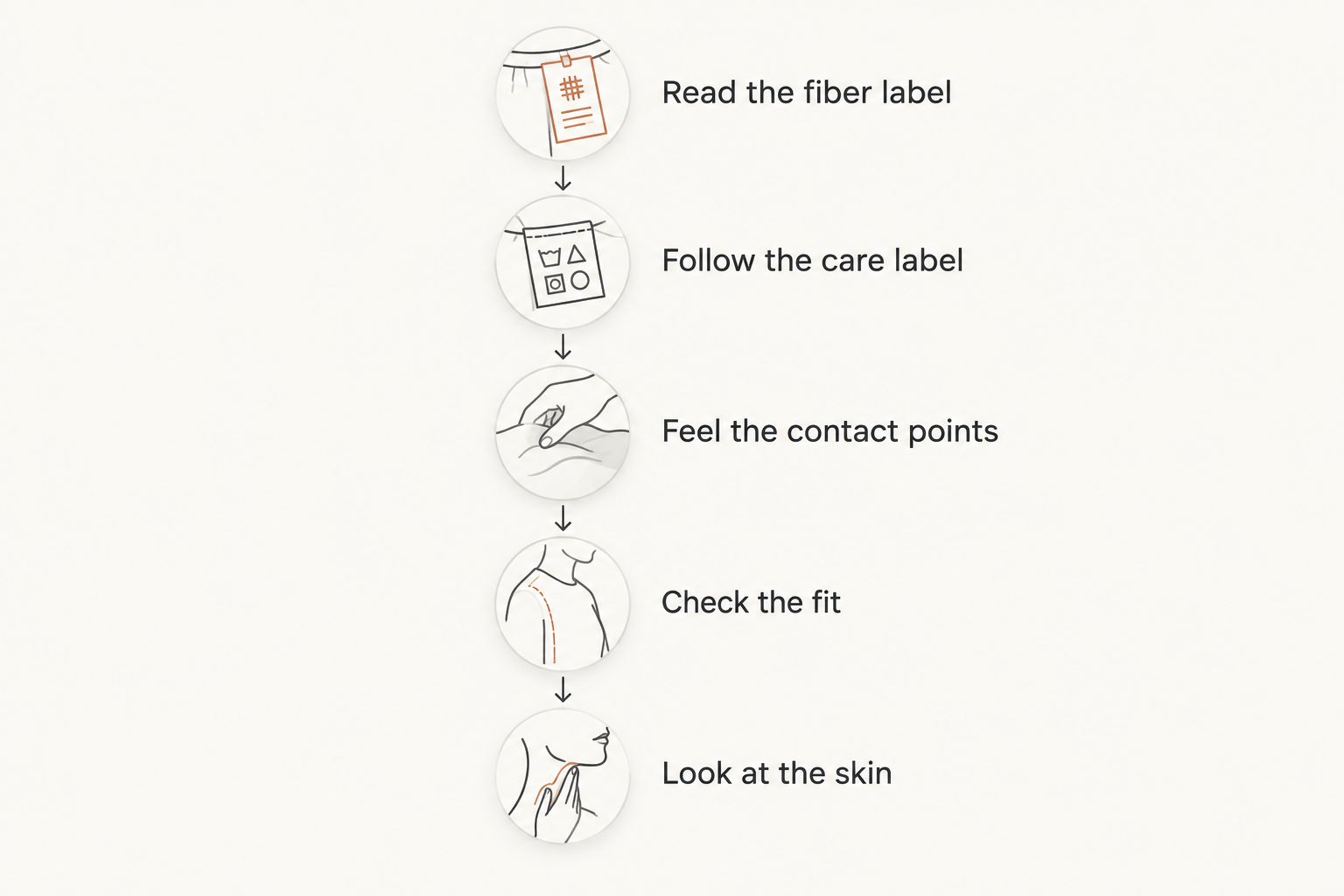
The best test starts with the specific garment. A sleeve, mitten, and gown can have different seams and closures even when their product names use the same fabric words. In 2026, use this short check before you put a new piece into the regular rotation:
- Read the fiber label. Look for the named fibers and any stated percentages. Do not assume every bamboo-organic-cotton item has the same composition.
- Follow the care label. Wash the garment before first wear and use the instructions for that item. A wash also gives you a chance to check how the fabric and closures feel afterward.
- Feel the contact points. Run a finger along seams, cuffs, tags, and fastenings. Those areas matter more than how soft the middle of the fabric feels in your hand.
- Check the fit on your baby. Look for bunching or pressure at the neck, wrists, ankles, and diaper area. Your baby should be able to move without a closure digging in.
- Look at the skin after wear. Pay attention to the places the garment touches. Stop using the item if you see irritation, and speak with your baby’s clinician if it continues.
A fabric choice is only one part of dressing a newborn comfortably. The garment also needs to fit the activity. A gown can make a diaper check easier; mitts and boots need closures that fit without rubbing. Choose the style for the moment, then assess the fabric on that exact item.
For a diaper change at 2 a.m., Goumikids’ 24 Hour Convertible Gown in Storm Gray is a bamboo-organic-cotton-blend option with a convertible design. Goumi's patented fold-over bottom opens for diaper access and closes into a sleeper covering baby's feet. Unlike an elastic-bottom gown that can ride up, it offers a closed-bottom option. Built-in black-and-white fold-over mitts let you cover or uncover the hands; check the exact style and size.
These are dressing features, not a promise against skin irritation. Choose layers for the room and your baby's needs rather than automatically adding a sleep sack or swaddle. Check its label, fit, and contact points before making it an everyday piece.
Does the type of bamboo fabric matter?
Yes. The actual fiber description matters more than the word bamboo in a headline. Bamboo is a plant source; a finished textile can involve processing and other fibers. That is why the sewn-in label is the place to check what the garment contains.
Keep three questions separate when you shop in 2026:
- What is it made from? Read the fiber names and percentages on the item. A description of bamboo alone is not a complete composition.
- How does it feel when worn? Softness in your hand is useful, but cuffs and seams meet skin differently when a baby moves.
- Is it practical to care for? Follow that garment’s washing instructions. The care routine matters when the next outfit change comes quickly.
Do not treat bamboo as an automatic sign that a piece is cleaner, safer, or better for sensitive skin than cotton. The useful question is narrower: does this washed, properly fitting garment suit your newborn? That answer comes from its label and how your baby does in it.
Is a bamboo-organic-cotton blend better than cotton alone?
Not for every newborn. A blend gives you a different fabric option, but neither the blend name nor the word organic guarantees that a baby will have no reaction. Compare complete garments rather than assuming one fiber wins on skin comfort.
If you’re choosing between a blend and cotton, start with the parts you can inspect. Is the label clear? Does the neckline sit comfortably? Can you change a diaper without repeatedly pulling fabric across your baby’s skin? Those questions help you choose something you’ll actually use, while leaving room for your baby’s individual response.
Goumikids makes bamboo-organic-cotton-blend mitts, boots, and convertible gowns for different dressing moments. Goumikids is best for parents who want practical closures alongside a bamboo-organic-cotton option, not a guarantee of irritation-free wear. That distinction matters when you’re buying a gift, too: useful design is something you can assess before the baby tries it on; skin tolerance is not.
Why newborns’ reactions to clothing vary
A newborn can seem comfortable in one piece and bothered by another with a similar fabric description. In 2026, check these garment-level differences before blaming or crediting bamboo alone:
- Fiber content: Product names can describe a blend without giving its exact composition. Read the label of the piece you’re using.
- Seams and edges: A soft panel does not tell you how a cuff or seam will feel against skin.
- Closure placement: Mitts and boots need to stay on, but a fastening also needs to sit comfortably.
- Fit: Fabric that bunches or pulls at the wrists, ankles, or neck can affect how an outfit feels.
- Care: Washing instructions differ by item. Follow the label and check the garment again after laundering.
- Your baby’s response: A comfortable-looking outfit still needs a skin check after wear.
These factors work together. If a baby has a mark at the wrist, inspect the cuff and closure as well as the fiber label. If discomfort appears under several different garments, don’t assume every fabric is the cause. A clinician can help you work out what needs attention.
Which bamboo-blend piece fits the moment?
Choose by what you’re trying to do, then verify the label and fit. A mitten does not solve a difficult diaper change; a gown does not keep a loose sock on. Goumikids has different bamboo-organic-cotton-blend pieces for those jobs, but no single style covers every need.
| Piece | Best for | Useful feature | Limitation to check |
|---|---|---|---|
| Stay-on 2-pack mitts in Storm Gray and Gridlock | Parents managing mitts that slip off | Adjustable two-part closure | Check the wrist fit and skin beneath the closure |
| 24 Hour Convertible Gown in Storm Gray | Parents who want a convertible gown for diaper checks | Convertible design | Check the garment’s label and fit for your baby |
| Stay On Boots in Rose | Parents tired of finding a missing sock | Adjustable two-part closure | Check that the ankle fastening sits comfortably |
The mitts’ product title specifies 0–6M, the gown’s specifies Preemie–6M, and the boots’ specifies 0–12M. Those are product-label size descriptions, not a substitute for assessing fit on your baby. In particular, a newborn and a preemie need the garment that fits them now, not a decision based on the upper end of a size label.


Should you wash bamboo-blend baby clothes before first wear?
Yes. Wash a new garment according to its care label before putting it on your newborn. Then feel the seams and closures again; the item your baby wears is the washed garment, not the fabric you touched in the package.
Avoid treating a particular detergent or wash setting as a fix for every skin reaction. If your baby develops irritation, stop using the garment and discuss persistent symptoms with your baby’s clinician. Keep the garment’s fiber and care labels available so you can describe what touched the skin.
Can bamboo fabric prevent newborn skin irritation?
No. Bamboo-derived fabric cannot promise to prevent irritation, and neither can a bamboo-organic-cotton blend. Comfort depends on the finished garment and your baby’s response, including what happens at seams, cuffs, and closures.
If you’re buying ahead of your baby’s arrival in 2026, pick pieces with clear labels and inspectable details. You cannot test a newborn’s tolerance before they wear an item. You can choose a garment whose composition and care instructions you can read and whose fit you can check once it’s on.
FAQ
Is bamboo fabric safe for newborn skin?
Yes, bamboo-derived fabric can be safe for newborn skin when the finished garment fits comfortably and does not cause irritation. Check the fiber label, wash the item as directed, and watch your baby’s skin after wear.
Is bamboo softer than cotton for babies?
The fiber name alone cannot tell you which finished garment will feel softer to your baby. Compare the actual items, including their seams, cuffs, and fit.
Is bamboo-organic-cotton clothing good for sensitive newborn skin?
A bamboo-organic-cotton blend is an option, not a guarantee against irritation. Read the exact item’s label and stop using it if your baby’s skin reacts.
Should I wash bamboo baby clothes before my newborn wears them?
Yes, wash new baby clothes before first wear according to the garment’s care label. Check the seams and closures again after washing.
How can I tell if a bamboo-blend mitten is too tight?
Check the fit at the wrist and look at the skin beneath the closure after wear. If the mitten rubs or leaves your baby uncomfortable, stop using that fit.
Can a preemie wear a bamboo-blend gown?
A preemie needs a gown that fits their current size and care needs. Check the exact product’s size and fiber labels, and follow the care team’s guidance if your baby is in the NICU.
Does the word bamboo tell me what a baby garment is made of?
No, bamboo in a product name does not provide the garment’s complete fiber composition. Read the sewn-in label for the actual fibers and stated percentages.
One last thing
The detail you’ll check most often isn’t on the front of the package. It’s where the fabric meets your baby: the wrist after a mitten comes off, the ankle during a sock check, or the neckline when you lift them for a change. Choose a clear label, a comfortable fit, and a garment you can use without a struggle. That is a more useful answer to the bamboo question in 2026 than any blanket claim about a fiber.